
Technical
What Is Inside a Catalytic Converter?
In the early 1980s, as environmental awareness grew, the automotive industry came to be seen as one of the main sources of air pollution. Catalytic converters became the most reliable means of reducing harmful exhaust emissions, and today they are a mandatory part of every new vehicle.
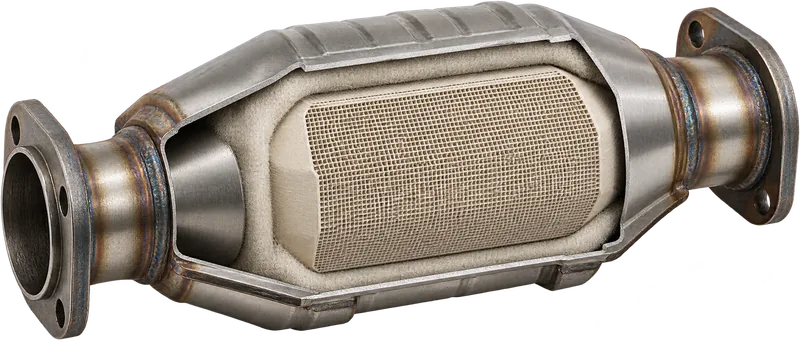
Parts of a catalytic converter
- Metal housing and heat shield — protect the core; the serial number is most often engraved on them.
- Insulation mat — holds the core in place and absorbs vibration and heat.
- Core (monolith) — most often a ceramic honeycomb with thousands of tiny channels through which the gases pass. On some vehicles the core is metal.
- Catalytic coating — a thin layer on the channel walls that contains precious metals: platinum, palladium and rhodium.
How a catalytic converter works
Through chemical reactions on the surface of the catalytic coating, the converter turns harmful exhaust substances — carbon monoxide, hydrocarbons and nitrogen oxides — into less harmful ones, such as carbon dioxide and water vapor.
Why a catalytic converter has buyback value
The precious metals in the catalytic coating can be recycled. That is why an old, faulty or replaced catalytic converter is not waste but a raw material. How much it is worth depends on the model — read more in our guide what determines the price of a catalytic converter.
Have an old catalytic converter?
Its core has value — request a valuation.